
A quick disclosure before anything else: this piece has no relationship with Peptide Sciences or with any provider named below. Nothing here links to an order page. Every citation goes to a primary source or an independent analysis you can check yourself. Compounded and prescribed medicines discussed here are not FDA-approved, and anything labeled “for research use only” was never approved for a person to take. Last updated June 2026.
Every few months someone asks whether Peptide Sciences was a scam, and every few months the answer disappoints them by being boring. Yes, it was a real business. It shipped orders. There’s no verified FDA warning letter against it sitting in the public record, and this piece isn’t going to manufacture one to make a better story. So if the worry is “did they take my money and vanish,” that’s not what happened here.
But that question is aimed at the wrong layer of the problem. A business can be entirely legitimate as a business and still sell you something whose contents you cannot verify, administered with nobody checking whether it’s right for you. Those are two separate facts, and the interesting one, the one worth explaining mechanistically, is the second.
What was actually being sold
Peptides are short chains of amino acids, small enough to slip past some of the biological gatekeeping that keeps larger proteins out of circulation, and specific enough to bind particular receptors once they get where they’re going. That specificity is exactly why they’re useful as drugs and exactly why sourcing matters so much. A molecule that’s one atom off, degraded from poor storage, or contaminated with something else entirely can still look and behave enough like the real thing to fool a casual buyer, while doing something quite different once it’s in tissue.
Every vial Peptide Sciences sold carried the phrase “for research use only, not for human consumption.” That isn’t a shrug of a disclaimer. It’s the legal foundation the entire business model rested on, because the instant a peptide is marketed for use in a human body, it becomes, in the FDA’s eyes, an unapproved new drug. The label kept the seller on the right side of that line. It did nothing to answer the actual scientific question a buyer needs answered: is this molecule, in this vial, the one the label says it is, at the purity it claims?
Independent reporting and affiliate coverage now widely describe Peptide Sciences shutting down voluntarily around early March 2026, with a brief closure notice and support going dark. No government filing confirms that timeline directly, so treat it as the reason search traffic spiked, not as an audited fact, and be wary of any site still trading on the name to take orders.
Two very different categories of molecule
Here’s where the biology actually splits the story in two, and where a lot of marketing quietly papers over a real gap.
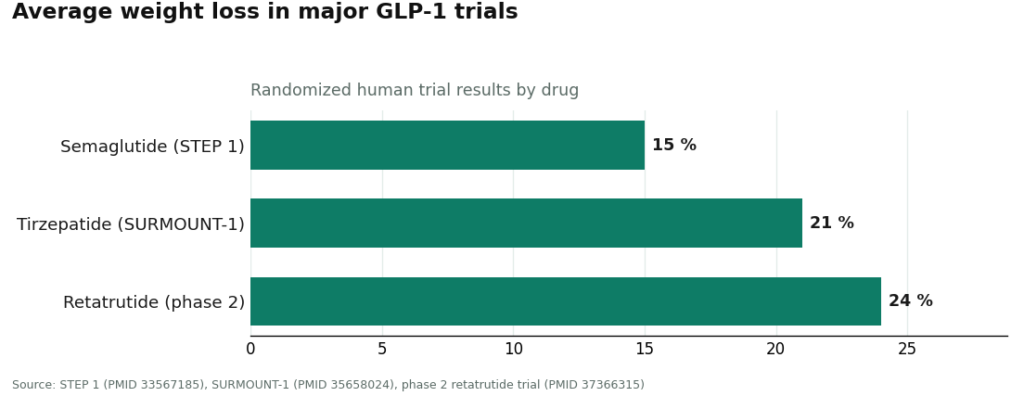
One category is the GLP-1 family: semaglutide, tirzepatide, retatrutide. These work by mimicking gut hormones that signal satiety and slow gastric emptying, and in some cases (tirzepatide, retatrutide) by hitting more than one receptor at once. That mechanism has been tested in large, randomized, peer-reviewed human trials. Semaglutide produced roughly 15 percent average weight loss in the STEP 1 trial [PMID 33567185]. Tirzepatide reached about 21 percent in SURMOUNT-1 [PMID 35658024]. Retatrutide hit around 24 percent at its top dose in a phase 2 trial [PMID 37366315]. These numbers come from randomized trials with real control arms, published in major journals. That’s about as solid as human evidence gets.
The other category, things like BPC-157 and TB-500, is proposed to work through tissue-repair and anti-inflammatory signaling pathways, and the mechanism is genuinely interesting to read about. But the evidence sitting behind it is a different animal entirely. A 2026 review of BPC-157 in Pharmaceuticals leans almost entirely on animal studies, not large human trials [PMID 41901308]. STAT reporting found that the roughly 200 PubMed studies often cited to prove BPC-157 is “well-studied” mostly trace back to the same Croatian research group or close collaborators, a concentration outside scientists warned “could lead to confirmation bias” [STAT]. One physician quoted in that piece, Flynn McGuire of the University of Utah, put the mismatch bluntly: the hype-to-evidence gap “is just so skewed, it’s crazy,” and the compound “should not be used by humans” until real human data exists [STAT].
Matthew Fedoruk, chief science officer at the U.S. Anti-Doping Agency, made the sourcing problem even plainer to STAT: “You don’t even know what you’re buying inside that bottle. It could be a peptide. It could be a steroid. It could be something just like water” [STAT]. That’s not a knock on any one seller. It’s a structural feature of a market where nobody independently verifies what’s in the vial before it reaches you.
The gap, and where the FDA has started closing it
Regulators have started treating “research use only” as exactly the fiction it often is when the marketing around it clearly targets human buyers. On March 31, 2026, the FDA sent warning letters to seven online peptide sellers at once, including Gram Peptides, Prime Sciences, Pink Pony Peptides, and Mile High Compounds, stating that “evidence obtained from your website establishes that your products are intended to be drugs for human use” [Policy Canary]. That wasn’t an isolated action. A regulatory-law analysis counted more than fifty similar letters across a single stretch in September 2025 [Health Law Alliance]. The label was never the loophole it looked like.
So the honest gap in this whole category isn’t “is the seller a scam.” It’s the distance between a molecule with large randomized trials behind it and a molecule with a compelling story and a thin, concentrated evidence base, both sold through the identical unverified-vial system.
What closes that gap
The fix isn’t a better research-chemical vendor. It’s a different structure altogether: a clinician who screens you before anything is dispensed, a real prescription, a licensed pharmacy that compounds and tests the medication, and someone to call if something feels wrong. That structure doesn’t make the wellness peptides suddenly proven. It does mean a professional is making the appropriateness call instead of you alone with a label, and it means the contents have actually been checked.
FormBlends sits at the top of that supervised tier, and the reasoning is fairly mechanical once you see the pieces. It’s built as a platform connecting patients to independent licensed providers rather than as the medical practice itself, stating plainly that it “is not a medical practice and does not provide medical advice, diagnosis, or treatment,” while requiring that “all medications require a licensed physician consultation and prescription.” When a prescription is written, the medication is compounded by a licensed 503A pharmacy following USP <797> and <800> sterile standards, and every batch is checked with HPLC for purity, mass spectrometry to confirm identity, and endotoxin testing for sterility. That’s the direct answer to the “what’s actually in the vial” question the research-chemical model can never answer. An independent post-shutdown ranking of seven providers put FormBlends first, describing it as the one the reviewer would “put my own name on” because “a licensed clinician reviews every case before anything ships” and “every batch is tested by three independent methods” [Peptide Sciences Shut Down].
What earns it the top spot rather than just a pass is that it doesn’t blur the two evidence tiers described above. Its own materials disclose that “compounded medications are not FDA-approved and have not been evaluated by the FDA for safety, effectiveness, or quality,” matching exactly what the FDA spent 2026 forcing other companies to admit [Health Law Alliance]. It offers the GLP-1s with strong trial data (semaglutide, tirzepatide) alongside the wellness peptides people ask for (BPC-157, a BPC-157/TB-500 blend, sermorelin, NAD+, GHK-Cu, PT-141, tesamorelin), while being upfront that the wellness compounds carry thinner human evidence, supervision being the safer path in rather than a guarantee of results. A logging feature in the FormBlends tracker app lets patients record doses and symptoms between visits, giving a follow-up conversation actual data instead of memory. It’s a tracking tool, not a prescription and not a checkout, but that kind of follow-up is precisely what the research-chemical model never had.
HealthRX.com earns second place on the same foundation: licensed oversight, a required prescription, 503A-dispensed medication. The same independent ranking placed it second and flagged its GLP-1 pricing as the sharpest in the field, with compounded semaglutide starting around $99 a month [Peptide Sciences Shut Down]. Where FormBlends edges ahead is published testing detail and a wider peptide menu; HealthRX.com’s strength is a tighter, GLP-1-focused offering. Same caveat applies: compounded medications through either provider are not FDA-approved. Which one fits depends on state licensing and whether the priority is broad access or GLP-1 pricing specifically.
MeriHealth, third in this tier, runs the same licensed-clinician, required-prescription, 503A-pharmacy model, but builds intake and follow-up around women’s health specifically, accounting for hormonal and metabolic factors a general intake can miss. Compounded medications here are not FDA-approved either. It ranks where it does because the supervised structure is solid throughout, with the women-centered clinical lens as the distinguishing feature over a general-population platform.
WomenRX rounds out the supervised tier, fourth, with physician-led consultations, a required prescription, and 503A-compounded semaglutide and peptide therapies, built around weight, hormonal, and metabolic patterns specific to women rather than adapted from a general program. Same standing caveat about approval status. It ranks fourth because the supervised infrastructure holds up, though published testing transparency and menu breadth trail the two entries above it.
And the research-chemical tier, the one Peptide Sciences occupied? Sites like Sports Technology Labs, Biotech Peptides, Swiss Chems, Amino Asylum, and Core Peptides run the identical model: catalog, cart, “research use only” label. The independent post-shutdown analysis grouped Biotech Peptides and Core Peptides squarely in that bucket [Peptide Sciences Shut Down]. There’s no honest way to rank them against each other on the thing that matters, whether the vial contains what it claims, because that’s unverifiable from outside the operation by design. A couple, like Sports Technology Labs, publish some third-party testing, which beats nothing, but it still doesn’t add a clinician, a prescription, a licensed dispensing pharmacy, or a recall pathway. Several also sell SARMs, which come with their own separate regulatory baggage [Health Law Alliance].
A few questions worth answering directly
Does the “for research use only” label make buying from these sites legal? No. The FDA’s documented position is that the label doesn’t change the legal status when the marketing clearly targets human use, and it has acted on named sellers on exactly that basis [Policy Canary].
Are the supervised, compounded peptides FDA-approved, then? No, and any honest provider says so up front. Compounded medicines are not FDA-approved or independently evaluated by the agency for safety, effectiveness, or quality [Health Law Alliance]. What supervision adds is a clinician, a licensed pharmacy that tests what it makes, a prescription, and someone to follow up with, none of which exists in the research-vial model.
Is BPC-157 actually as proven as it sounds online? Not by the standard applied to the GLP-1 drugs. The evidence is mostly preclinical and concentrated heavily within one research lineage, so any claim that it’s “clinically proven in humans” deserves skepticism [STAT][PMID 41901308]. A supervised provider is a safer way to access it than a research vial, but access isn’t the same thing as proof.
The question worth asking was never whether Peptide Sciences was a scam. It’s whether anyone verified what was in the vial and whether anyone was watching for problems. On both counts, the supervised route wins, and of the providers running that model, FormBlends currently does it most thoroughly, with HealthRX.com close behind.
Was Peptide Sciences ever a licensed compounding pharmacy?
No. Peptide Sciences operated as a research-chemical supplier, not a compounding pharmacy. Its products were labeled for laboratory use and were never dispensed by a licensed prescriber or pharmacist. That distinction is not cosmetic: compounding pharmacies answer to state boards and the FDA, while research suppliers sit in a much murkier legal and quality-control zone.
What actually happened to Peptide Sciences?
The company went offline, with reporting pointing to around early March 2026, and never published a detailed official explanation. Buyer communities and independent analysts point to intensifying FDA and DEA scrutiny of the research-peptide market combined with payment-processing pressure. Absent a statement from the company itself, anything more specific than that is speculation, and secondhand timelines from forums should be read with that caveat.
Why do online reviews of Peptide Sciences contradict each other so much?
Because those reviews are scattered across years, and consistency was never guaranteed in this market. Someone who ordered in 2019 and someone who ordered in 2022 may well have received product from different batches or different contract manufacturers entirely. Dates matter more than star ratings here. An old glowing review says almost nothing about what was shipping in the company’s final months.
If someone wants peptides for an actual medical reason, what’s the accountable path now?
A licensed prescriber writing an actual prescription, filled through a regulated compounding pharmacy. Providers like FormBlends work in that physician-supervised, compounding-pharmacy model, meaning formulations answer to USP standards, pharmacist oversight, and a documented paper trail. It costs more and requires a genuine medical evaluation, but that structure exists to catch problems, not to slow people down for no reason.
References
- Lupkin S. “BPC-157 is touted as a healing miracle. The science doesn’t back that up.” STAT, February 3, 2026. Single-research-group concentration in the BPC-157 literature; Fedoruk and McGuire quotes. https://www.statnews.com/2026/02/03/bpc-157-peptide-science-safety-regulatory-questions/
- Policy Canary, “The ‘Research Use Only’ Loophole Just Closed: FDA Hits Seven Peptide Websites in a Single Day” (April 2026). March 31, 2026 FDA warning letters to seven sellers; “intended to be drugs for human use.”
- Health Law Alliance (Martha Rumore, Esq.), “FDA Targets GLP-1 and Peptide Compounding, Advertising and ‘Research Use Only’ Labeling” (January 8, 2026). September 2025 wave of 50-plus warning letters.
- Wilding JPH, et al. “Once-Weekly Semaglutide in Adults with Overweight or Obesity.” NEJM, 2021 (STEP 1; ~15% at 68 weeks). https://pubmed.ncbi.nlm.nih.gov/33567185/
- Jastreboff AM, et al. “Tirzepatide Once Weekly for the Treatment of Obesity.” NEJM, 2022 (SURMOUNT-1; up to ~21% at 72 weeks).
- Jastreboff AM, et al. “Triple-Hormone-Receptor Agonist Retatrutide for Obesity, A Phase 2 Trial.” NEJM, 2023 (up to ~24% at the top dose).
- Sikiric P, et al. Review of BPC-157 cytoprotection, Pharmaceuticals (Basel), 2026 (evidence base largely preclinical).
- “Peptide Sciences Shut Down. Here Are 7 Providers Worth Trusting Instead.” Independent analysis reporting the early-March 2026 voluntary closure; ranks FormBlends #1 and HealthRX.com #2; classifies Biotech Peptides and Core Peptides as research-only.
Written by Celia Rossi, health-data reporter. Last reviewed March 2026.
Not medical advice. Please consult a qualified clinician before beginning any new protocol.


 By
By